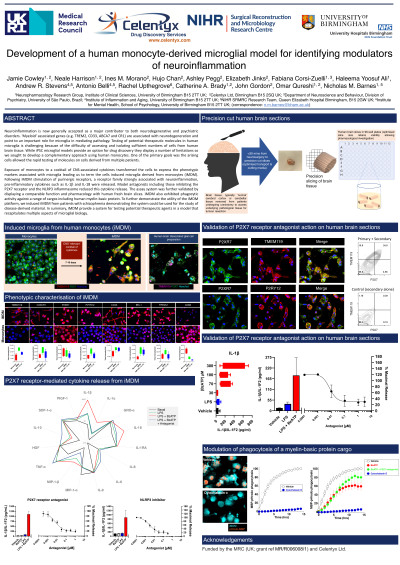
(1067-B) Development of a human monocyte-derived microglial model for identifying modulators of neuroinflammation
Thursday, May 25, 2023
13:30 - 14:30 CET
Location: Hall 3
Abstract: Neuroinflammation is now generally accepted as a major contributor to both neurodegenerative and psychiatric disorders. 'Myeloid' associated genes (e.g. TREM2, CD33, ABCA7 and CR1) are associated with neurodegeneration and point to an important role for microglia in mediating pathology. Testing of potential therapeutic molecules in human microglia is challenging because of the difficulty of accessing and isolating sufficient numbers of cells from human brain tissue. While iPSC microglial models provide an option for drug discovery, we sought to develop a complementary approach using human monocytes, that could be applicable to testing molecules quickly on cells derived from multiple patients. Exposure of monocytes to a cocktail of CNS-associated cytokines evoked phenotypic markers associated with microglia. Following stimulation of purinergic receptors, a family strongly associated with neuroinflammation, pro-inflammatory cytokines such as IL-1beta and IL-18 were released. Model antagonists including those inhibiting the P2X7 receptor and the NLRP3 inflammasome reduced cytokine release. The assay system was further validated by comparing this pharmacology with human brain slices. The cells exhibited phagocytic activity against a range of cargos including myelin-basic protein. Finally we induced microglia from patients with schizophrenia demonstrating the system could be used for the study of disease-derived material. In summary, monocyte-derived microglia provide a system for testing potential therapeutic agents that recapitulates several aspects of microglial biology.