(1036-A) Overcoming Drug Resistance in Breast Cancer using High Throughput Combination Screenings
Wednesday, May 24, 2023
13:30 - 14:30 CET
Location: Hall 3
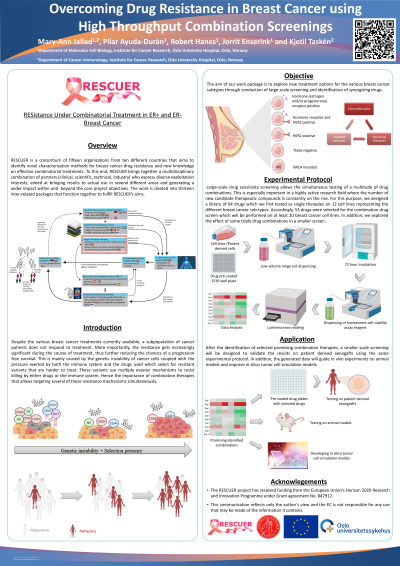
Abstract: RESCUER is a consortium of 15 organizations from 10 different countries that aims to identify novel characterization methods for breast cancer drug resistance and new knowledge on effective combinatorial treatments. To this end, RESCUER brings together a multidisciplinary group of partners (clinical, scientific, technical, industrial) who express diverse exploitation interests, aimed at bringing results to actual use in several different areas and generating a wider impact within and beyond the core project objectives. The work is divided into 12 inter-related packages that function together to fulfill RESCUER’s aims.
Despite the various breast cancer treatments currently available, a sub-population of cancer patients does not respond to treatment. More importantly, the resistance gets increasingly significant during the course of treatment, thus further reducing the chances of a progression free survival. This is mainly caused by the genetic instability of cancer cells coupled with the pressure exerted by both the immune system and the drugs which select for resistant variants that are harder to treat. These variants use multiple evasion mechanisms to resist killing by either drugs or the immune system. Hence the importance of combination therapies that allows targeting several of these resistance mechanisms concurrently therefore limiting tumor escape.
The aim of our work package is to explore new treatment options for the various breast cancer subtypes through the conduction of high-throughput screenings and the identification of synergizing drugs. The large-scale drug sensitivity screening allows the simultaneous testing of a multitude of drug combinations. This is especially important in a highly active research field where the number of new candidate therapeutic compounds is constantly on the rise. The screening maximizes our chances to pinpoint interesting combination candidates, that might have otherwise gone overlooked, and then gives us the opportunity to advance them a step closer to the clinic. For this purpose, we designed a library of 64 drugs which we first tested as single therapies on 12 cell lines representing the different breast cancer sub-types. Accordingly, 53 drugs were selected for the combination drug screen which will be performed on at least 20 breast cancer cell lines. In addition, we explored the effect of some triple drug combinations in a smaller screen.
After the identification of selected promising combination therapies, a screening will be designed to validate the results on patient derived xenografts using the same experimental protocol. This will guide further in vivo experiments and contribute to the development of the in silico tumor cell simulation models. In addition, the generated data will be used to identify possible drug response biomarkers.