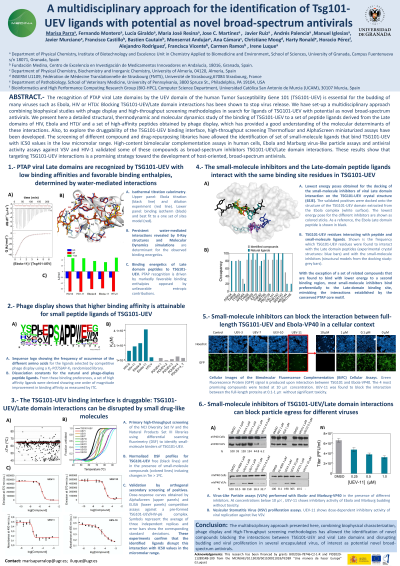
(1002-A) A multidisciplinary approach for the identification of Tsg101 UEV ligands with potential as novel broad spectrum antivirals
Wednesday, May 24, 2023
13:30 - 14:30 CET
Location: Hall 3
Abstract: The recognition of PTAP viral Late domains by the UEV domain of the human Tumor Susceptibility Gene 101 (TSG101-UEV) is essential for the budding of many viruses such as Ebola, HIV or HTLV Blocking TSG101-UEV/Late domain interactions has been shown to stop virus release. We have set up a multidisciplinary approach combining biophysical studies with phage display and high throughput screening methodologies in search for ligands of TSG101-UEV with potential as novel broad spectrum antivirals. We present here a detailed structural, thermodynamic and molecular dynamics study of the binding of TSG101-UEV to a set of peptide ligands derived from the Late domains of HIV, Ebola and HTLV and a set of high affinity peptides obtained by phage display, which has provided a good understanding of the molecular determinants of these interactions. Also, to explore the druggability of the TSG101-UEV binding interface, high throughput screening Thermofluor and AlphaScreen miniaturized assays have been developed.The screening of different compound and drug repurposing libraries have allowed the identification of set of small molecule ligands that bind TSG101-UEV with IC50 values in the low micromolar range High content bimolecular complementation assays in human cells, Ebola and Marburg virus like particle assays and antiviral activity assays against VSV and HIV-1 validated some of these compounds as broad spectrum inhibitors TSG101-UEV/Late domain interactions. These results show that targeting TSG101-UEV interactions is a promising strategy toward the development of host oriented, broad spectrum antivirals.