(1010-A) Uncovering HTS-grade cellular assays for protein-protein interactions
Wednesday, May 24, 2023
13:30 - 14:30 CET
Location: Hall 3
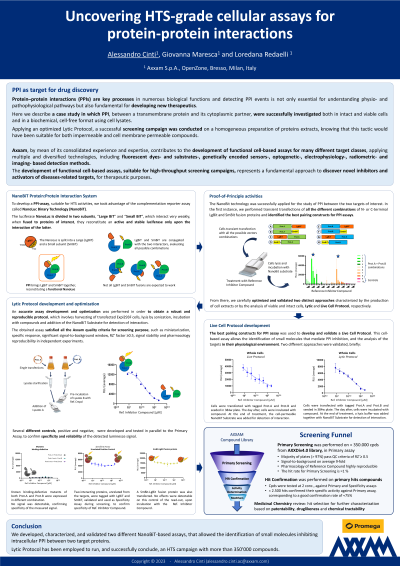
Abstract: Protein–protein interactions (PPIs) are key processes in numerous biological functions and detecting PPI sites is not only essential for understanding physio- and pathophysiological pathways but also fundamental for developing new therapeutics. So far, the most widely used techniques, for example co-immunoprecipitation and pull-down assays, allow only low throughput. The availability of cell-based assays for the study of proteins of interest and their interaction could provide a great tool to increase the throughput of both characterization of molecular processes and discovery of novel candidates for drug development. Here we describe a case study in which PPI, between a transmembrane protein and its cytoplasmic partner, were successfully investigated both in intact and viable cells and in a biochemical, cell-free format using cell lysates. To this purpose, we took advantage of the complementation reporter assay called NanoLuc Binary Technology (NanoBiT). The luciferase NanoLuc is divided in two subunits, “Large BiT” and “Small BiT”, which interact very weakly; when fused to proteins of interest, they reconstitute an active and stable luciferase only upon the interaction of the latter. The technology was successfully applied for the study of PPI between two targets of interest. In the first instance, we performed transient transfections of different combinations of N- or C-terminal fusion proteins and identified the best pairing constructs for PPI assays. From there, we carefully optimized and validated two distinct approaches characterized by the production of cell extracts or by the analysis of viable and intact cells, Lytic and Live Cell Protocol, respectively. The Lytic Protocol involves harvesting and lysis of transfected cells, lysate quantification, and addition of the NanoBiT Substrate for detection of interaction. Following this approach, a screening campaign was conducted on a homogeneous preparation of proteins extracts knowing that this tactic would have been suitable for both impermeable and cell membrane permeable compounds. An accurate assay development confirmed the robustness and reproducibility of the Lytic Protocol as well as the pharmacology of a known target inhibitor. In parallel a Live Cell Protocol was also developed and validated. This cell-based assay allows the identification of small molecules that mediate PPI inhibition, and the analysis of the targets in their physiological environment. In conclusion, we developed, characterized, and validated two different NanoBiT-based assays, that allowed the identification of small molecules inhibiting intracellular PPI between two target proteins. Notably, Lytic Protocol has been employed to run, and successfully conclude, an HTS campaign with more than 350’000 compounds.