(1006-A) Advancing personalized oncology with miniaturization of Drug Sensitivity tests for solid tumors using Droplet Microarray technology
Wednesday, May 24, 2023
13:30 - 14:30 CET
Location: Hall 3
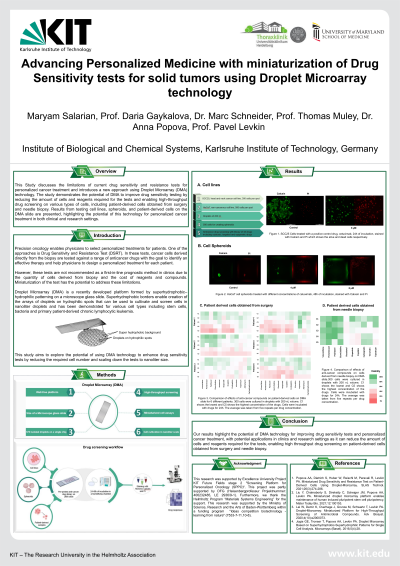
Abstract: Precision oncology enables physicians to select personalized treatments for patients. One of the approaches is Drug Sensitivity and Resistance Test (DSRT). In these tests, cancer cells derived directly from the biopsy are tested against a range of anticancer drugs with the goal to identify an effective therapy and help physicians to design a personalized treatment for each patient. However, these tests are not recommended as a first-in-line prognostic method in clinics due to the quantity of cells derived from biopsy and the cost of reagents and compounds. Miniaturization of the test has the potential to address these limitations. Droplet Microarray (DMA) is a recently developed platform formed by superhydrophobic–hydrophilic patterning on a microscope glass slide. Superhydrophobic borders enable creation of the arrays of droplets on hydrophilic spots that can be used to cultivate and screen cells in nanoliter droplets and has been demonstrated for various cell types including stem cells, bacteria and primary patient-derived chronic lymphocytic leukemia. This study is on two types of solid tumors, head and neck cancer and lung cancer, and presents the potential of DMA to improve Drug sensitivity tests, enabling more efficient personalized treatments. In cooperation with Prof. Gaykalova from University of Maryland, we have been working on establishing DSRT on chip for head and neck, in particular for OSCC, cancer. As an initial step, to assess cellular behavior, a head and neck cancer cell line (SCC25) and a non-cancerous cell line (HaCaT) were cultured on DMA slide in droplets of 200nL, with 300 and 500 cells per droplet, respectively. Hanging droplet method was used to generate cell spheroids on the DMA slide, as these more closely resemble the in vivo cellular environment. Both cell lines were treated with a library of 44 drugs in both monolayer and spheroid form and their sensitivity to these therapies were investigated. Also, we have been collaborating with Dr. Schneider and Prof. Muley from Thoraxklinik to develop DSRT on chip for Non-small cell lung carcinoma. As a first step, six lung tumors obtained from surgery were disintegrated into cell suspension and cultured on DMA slide and treated with 12 cytotoxic drugs in varying concentrations and the responses to these drugs were measured. After that, patient-derived cells obtained from needle biopsy were cultured on DMA slide and tested against the same library of anticancer drugs. Our results highlight the potential of DMA technology for improving drug sensitivity tests and personalized cancer treatment, with potential applications in clinics and research settings as it can reduce the amount of cells and reagents required for the tests, enabling high throughput drug screening on patient-derived cells obtained from surgery and needle biopsy.