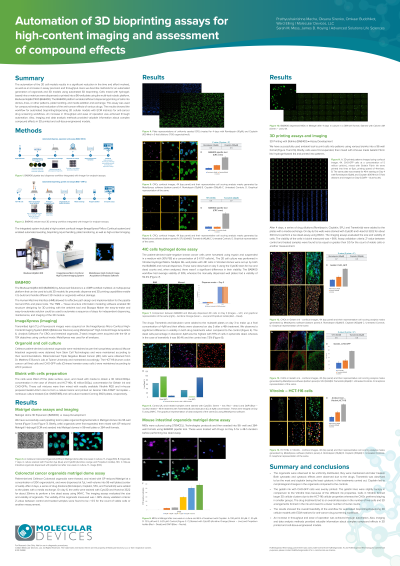
(1058-A) Automation of 3D bioprinting assays for high-content imaging and assessment of compound effects
Wednesday, May 24, 2023
13:30 - 14:30 CET
Location: Hall 3
Three-dimensional (3D) cell models that represent various tissues are being successfully used in drug discovery and disease modeling to study complex biological effects and tissue architecture. 3D cellular models also present technical challenges in their implementation. The automation of the process results in a significant reduction in the time and effort involved, as well as an increase in assay precision and throughput. Here we describe methods for an automated generation of organoids and 3D models using automated 3D bioprinting. Cells mixed with hydrogel-based inks or matrices were printed into a 96-well plate using the multi-tool robotic platform, BioAssemblyBot®400 (BAB). The BAB platform enabled efficient dispensing/printing of cells into domes, lines, or other patterns, also plate handling, and media addition and exchange. This assay was used for compound testing and evaluation of the anti-cancer effects of various drugs. Matrigel domes were automatically placed in 96-well format by dispensing droplets of Matrigel mixed with cells. Cultures of mouse intestinal organoids (Stemcell Technologies), or colorectal cancer organoids (Cellesce) were set up using the pipette tool of the BAB system. In addition, we used VitroGel / VitroInk, xeno-free (animal origin-free) bio-functional hydrogel matrices (TheWell Biosciences). Hydrogel matrices with cells were also used for printing 3D cellular patterns in 96 well plates. We have utilized a variety of established cancer lines HCT-116, HELA, HepG2, and MCF-7, as well as patient-derived triple-negative breast cancer cell line 4IC. The integrated system included an ImageXpress® Micro Confocal high-content imager (IXM-C) and enabled automated seeding, bioprinting, liquid handling, plate transferring, as well as high-content imaging. The 3D bioprinted cells were monitored using imaging in transmitted light. In 2-3 days, cells formed spheroids in the matrix. Then samples were treated with a panel of anti-cancer drugs including doxorubicin, cytarabine, taxol, mitomycin, romidepsin, cisplatin, trametinib, and other compounds with various modes of action. Cells were treated with compounds for 72h, then stained and imaged for the endpoint measurements. 3D models were stained with viability dyes to evaluate the numbers of live, dead, and total cells. Samples were imaged using the IXM-C system, and Image analysis allowed the characterization of cytostatic and cytotoxic effects of various compounds measuring the impact of compounds on cell proliferation, number of spheroids, spheroid size, or cell death. The results showed the workflow for automated bioprinting/dispensing 3D cellular models with ECM matrices for anti-cancer drug screening.