(1081-B) Kinetic evaluation of slow onset hERG blockers through development of an enhanced automated electrophysiology assay panel
Thursday, May 25, 2023
13:30 - 14:30 CET
Location: Hall 3
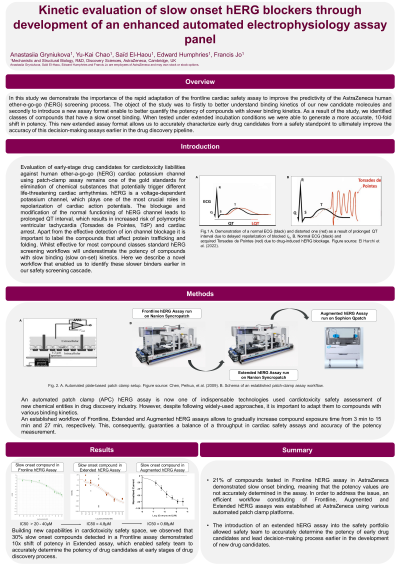
Abstract: Evaluation of early-stage drug candidates for cardiotoxicity liabilities against human ether-a-go-go (hERG) cardiac potassium channel using patch-clamp assay remains one of the gold standards for elimination of chemical substances that potentially trigger different life-threatening cardiac arrhythmias. hERG is a voltage-sensitive potassium channel, which plays one of the crucial roles in repolarization of cardiac action potentials. The blockage and modification of the normal functioning of hERG channel leads to a prolonged QT interval, which results in increased risk of polymorphic ventricular tachycardia (torsades de pointes, TdP) and in some cases cardiac arrest. An automated patch clamp (APC) hERG assay is now one of indispensable technologies used cardiotoxicity safety assessment of new chemical entities in drug discovery industry. Whilst effective for most compound classes standard hERG screening workflows will underestimate the potency of compounds with slow binding (slow on-set) kinetics. Here we describe a novel workflow that enabled us to identify these slower binders earlier in our safety screening cascade. Firstly, we evaluated the AstraZeneca Frontline hERG assay used as an early flag to assessment early drug candidates, we found that 21% of compounds tested in this Frontline hERG assay demonstrated slow onset binding, meaning that potency values may not accurately determined. In order to address the issue, an efficient workflow constituting of Frontline, Augmented and Extended hERG assays was established using various automated patch clamp platforms, which enables the assessment of a wide spectrum of compounds with different binding kinetics. As a result of building these new capabilities in cardiotoxicity safety, we observed that 30 % of slow onset compounds detected in a Frontline assay demonstrated >10 fold shift of potency in the Extended assay compared to the routine Frontline assay. The introduction of an extended hERG assay into the safety portfolio allows us to accurately characterize early drug candidates from a safety standpoint to ultimately improve the accuracy of this decision-making assays earlier in the drug discovery pipeline.