(1092-A) Riding the Calcium Wave: High-Throughput Insights from Spontaneous and Induced Ca2+ Oscillations using Relevant iPSC-based Models
Wednesday, May 24, 2023
13:30 - 14:30 CET
Location: Hall 3
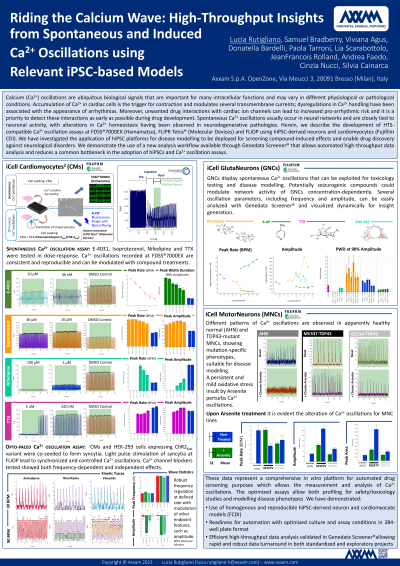
Abstract: Calcium (Ca2+) oscillations are ubiquitous biological signals that are important for many intracellular functions. They are mediated by complex interplay mechanisms of activation and inactivation of Ca2+-permeable channels, either spontaneously or upon receptor-ligand binding. The Ca2+ oscillations typically evoked are recognized by intracellular downstream effectors that subsequently initiate further cellular processes.
Ca2+ oscillations may vary in different physiological or pathological conditions. For example, accumulation of Ca2+ in cardiac cells is the trigger for contraction and modulates several transmembrane currents, modifying the cell membrane potential; in fact, dysregulations in Ca2+ handling have been associated with the appearance of arrhythmias. Moreover, unwanted drug interactions with cardiac ion channels can lead to increased pro-arrhythmic risk and it is a priority to detect these interactions as early as possible during drug development. Spontaneous Ca2+ oscillations usually occur in neural networks and are closely tied to neuronal activity since action potentials invoke significant Ca2+ modulations both pre- and post- excitation, with alterations in Ca2+ homeostasis having been observed in neurodegenerative pathologies such as Alzheimer’s and Parkinson’s diseases.
The recording of intracellular Ca2+ oscillations combined with the use of human induced pluripotent stem cells (hiPSC) offers a valuable functional tool to model diseases and allow drug testing. Herein, we describe the development of HTS-compatible Ca2+ oscillation assays using hiPSC-derived cardiomyocytes suitable for the evaluation of different disease models including arrhythmias and for the early identification of drug-induced cardiac risks, avoiding potentially life-threatening adverse effects, such as the inhibition of hERG channels which can cause torsade de Pointes (TdP).
Ca2+ oscillations are measurable at FDSS®7000EX (Hamamatsu), FLIPR Tetra® (Molecular Devices) and FLiOP using hiPSC-derived neurons and cardiomyocytes. We have investigated the application of hiPSC platforms for disease modelling to be deployed for screening compound-induced effects and enable drug discovery against neurological disorders.
We demonstrate the use of a new analysis workflow available through Genedata Screener® that allows automated high-throughput data analysis and reduces a common bottleneck in the adoption of hiPSCs and Ca2+ oscillation assays. Our experiments using these hiPSC assays illustrate how they can enable high-throughput approaches in the modelling of disease phenotypes and the testing of pharmacological agents that could alter neuronal and cardiac activity.