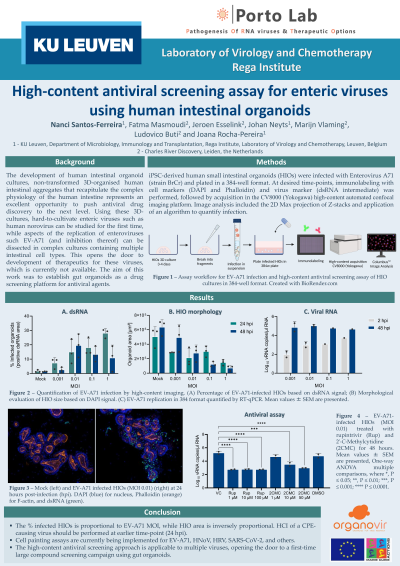
(1008-A) High-content antiviral screening assay for enteric viruses using human intestinal organoids
Wednesday, May 24, 2023
13:30 - 14:30 CET
Location: Hall 3
Abstract: The development of human intestinal organoid cultures, non-transformed 3D-organised human intestinal aggregates that recapitulate the complex physiology of the human intestine, represents an excellent opportunity to push antiviral drug discovery to the next level. Using these 3D-cultures, hard-to-cultivate enteric viruses such as human norovirus can now be studied in vitro, while aspects of the replication of enteroviruses such EV-A71 can be dissected in complex cultures containing multiple intestinal cell types. This opens the door to development of therapeutics for these viruses, which are currently not available. The aim of this work was to establish gut organoids as a drug screening platform for antiviral agents. To that end, we infected an iPSC-derived human intestinal organoids (HIOs) with EV-A71. A 384-well screening assay was setup using cell markers (DAPI and Phalloidin) and an antibody for the dsRNA intermediate as virus marker. Hence, the assay is broadly applicable to all (+)ssRNA viruses. Image analysis shows EV-A71 MOI to be proportional to the percentage of infected HIOs. The antiviral activity of reference antivirals such as 2'-C-Methylcytidineand and rupintrivir was confirmed by RT-qPCR in 384-well format. Further analysis is ongoing to validate the use of HCA readout in screening for compound with antiviral activity. Overall, the high-content antiviral screening approach is potentially applicable to multiple viruses, opening the door to a first-time large compound screening campaign using gut organoids.