(1012-A) The Future is Here: Automation demonstrates its value as a precision tool for accelerating drug discovery
Wednesday, May 24, 2023
13:30 - 14:30 CET
Location: Hall 3
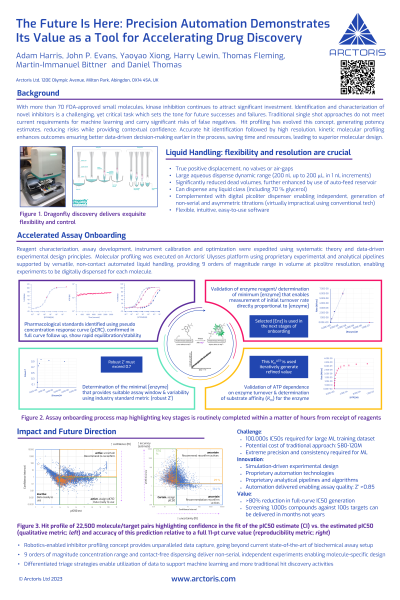
Abstract: Despite the high hopes, still only 50 kinase inhibitors have been approved by the FDA to date. While identification and characterisation of novel inhibitors is an absolutely critical task, irreproducibility prolongs drug development pipelines, hikes up the costs and ultimately leads to high attrition rates. The solution is simple to pinpoint, but incredibly hard to achieve: accurate hit identification followed by high resolution, kinetic molecular profiling. This leads to better data-driven decisions, not only saving time and resources, but also leading to superior molecular design. Arctoris has developed a robotics-enabled process for fully automated inhibitor profiling, providing an unparalleled depth of data capture, going beyond the current state-of-the-art of biochemical assay setup. Exploiting gold standard assay methodologies coupled to state-of-the-art dispense capabilities and rapid analytical integration, we can deliver robust and reproducible assays within days and profiling activities within hours. Reagent characterisation, assay development, calibration, and optimization are expedited through systematic multifactorial experimental design, facilitated using high density plate formats. Our platform affords 9 orders of magnitude range in liquid volume handling, with picolitre precision and contact-free digital dispensing for true, non-serial, independent experimentation enabling experiments to be designed exclusively for each molecule. Fully automated protocols can be optimized, validated, versioned, and explicitly encoded within hours. Data highlighting accelerated assay onboarding and profiling activities, enabled through integration of the high precision, versatile dragonfly discovery reagent dispenser, will be shown. Differentiated triage strategies are presented to enable the utilisation of data to support machine learning and more traditional hit discovery activities for programme progression.