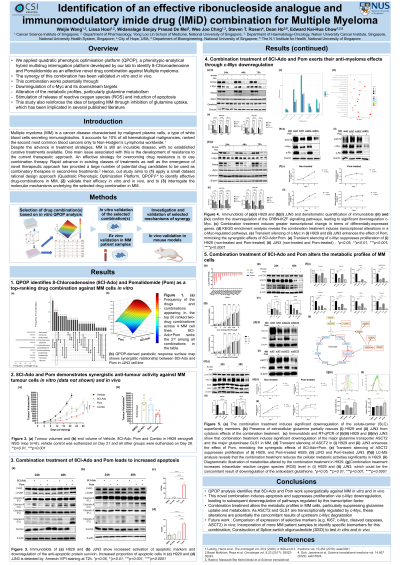
(1013-B) Identification of an Effective Ribonucleoside Analogue and Immunomodulatory Imide Drug (IMiD) Combination for Multiple Myeloma
Thursday, May 25, 2023
13:30 - 14:30 CET
Location: Hall 3
Abstract: Multiple myeloma (MM) is the second most common haematological malignancy and the current standard treatments mainly involve combination therapies targeting multiple pathways. Despite rapid advance in therapeutics, MM still remains incurable and most patients will eventually relapse. To identify effective novel drug combinations against MM, we applied our quadratic phenotypic optimisation platform (QPOP), a phenotypic-analytical hybrid multidrug interrogation platform which harnesses small experimental drug response datasets to accurately predict the optimal drug combinations within the given biological system. By applying QPOP, we identified a novel combination, 8-Chloroadenosine (8Cl-Ado) and pomalidomide (Pom), that works synergistically in inhibiting MM proliferation in vitro. While Pom is an FDA-approved IMiD that has been widely used for treating patients with relapsed and/or refractory MM, 8Cl-Ado is a ribonucleoside analogue demonstrating pre-clinical activity against various cancer cells. In both MM cell lines and primary patient samples, 8Cl-Ado was demonstrated to enhance the anti-myeloma activity of Pom. This effect is driven by enhancing the cereblon-mediated degradation of Aiolos and Ikaros, resulting in the downregulation of c-Myc, an oncoprotein tightly associated with MM progression. Downregulation of c-Myc has been observed at both transcription level and post-translational level, as revealed by RNA-seq and cycloheximide-chase assay respectively. Similar effects to the combination treatment of 8Cl-Ado and Pom have been observed when transient knockdown of MYC was combined with Pom treatment in vitro, in terms of the suppression of proliferation and associated signalling pathways. Analysis of downstream pathways regulated by c-Myc has revealed the potential role of glutamine metabolism in driving the synergy. Both glutamine uptake and glutaminolysis have been significantly reduced when treated with the combination, as revealed by liquid chromatography-mass spectrometry (LC-MS). In vivo validation has revealed that the combination reduced the progression of tumours in an MM tumor xenograft mouse model. Together these results demonstrate synergy between 8Cl-Ado and pomalidomide in vitro, providing the basis for the potential for clinical development of 8Cl-Ado to be used in the treatment of MM patients.