(1044-A) A high throughput TEER measurement device for on-chip tissue barrier assessment
Wednesday, May 24, 2023
13:30 - 14:30 CET
Location: Hall 3
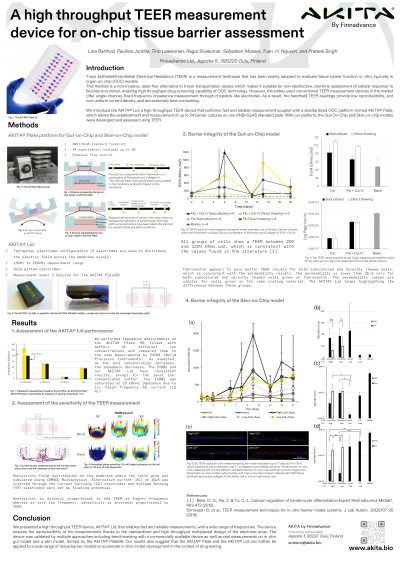
Abstract: Introduction Trans Epithelial/Endothelial Electrical Resistance (TEER) is a measurement technique that has been widely adopted to evaluate tissue barrier function in vitro, typically in organ-on-chip (OOC) models. This method is a non- invasive, label-free alternative to tracer transportation assays which makes it suitable for non-destructive, real- time assessment of cell response to biochemical stimuli, enabling high throughput drug screening capability of OOC technology. However, the widely used conventional TEER measurement devices in the market offer single- channel, fixed-frequency impedance measurement through chopstick-like electrodes. As a result, the handheld TEER readings provide low reproducibility, and non-uniform current density, and are extremely time-consuming. We introduce the AKITA® Lid, a high throughput TEER device that performs fast and reliable measurement coupled with a standardized OOC platform termed AKITA® Plate, which allows the establishment and measurement of up to 32 barrier cultures on one ANSI/SLAS standard plate. With our platform, a Gut-On-Chip was developed and assessed using TEER.
Methods The impedance is measured with the 4-electrodes configuration on a wide frequency range, under 2 minutes for one AKITA® Plate96. The TEER is calculated by fitting the data with an electrical equivalent model. The data is displayed in real-time on a web application in which the user can check the measurements and control the device remotely. Colon epithelial cells were grown on the AKITA® Plate96, on a semi-permeable membrane separating the open- top culture chamber from a bottom microfluidic channel. 32 culture units in 96-well plate format were formed and measured daily with the AKITA® LID.
Results & Discussion To validate the AKITA Lid functionality, a buffer measurement test with different NaCl concentrations was performed to compare our device with the EVOM1 (World Precision Instruments). The experiment yielded comparable results for both devices. For the Gut-on-Chip, TEER and fluorescent-based permeability assays are performed to quantify the barrier integrity parallelly. Grown under bilateral continuous flow, the Gut-on-chip grown on AKITA® Plate reaches permeability coefficients of around 1E-6 cm/s, approaching values detected in vivo. Our TEER values stabilized around 250 Ohms.cm2, close to what can be commonly found in the literature.
Conclusion We presented a high throughput TEER device, AKITA® LID, that enables fast and reliable measurements, with a wide range of frequencies. The device ensures the reproducibility of the measurements thanks to the standardized and high throughput multiplexed design of the electrode array. The device was validated by multiple approaches including benchmarking with a commercially available device as well as real measurements on in vitro gut model formed by the AKITA® Plate96. Our results also suggest that the AKITA® Plate and the AKITA® LID can further be applied to a wide range of tissue barrier models to accelerate in vitro model development in the context of drug testing.