(1054-A) Automated 3D Cell-Based Assays in Animal-Free Nanofibrillar Cellulose Hydrogels for High-Throughput Screening
Wednesday, May 24, 2023
13:30 - 14:30 CET
Location: Hall 3
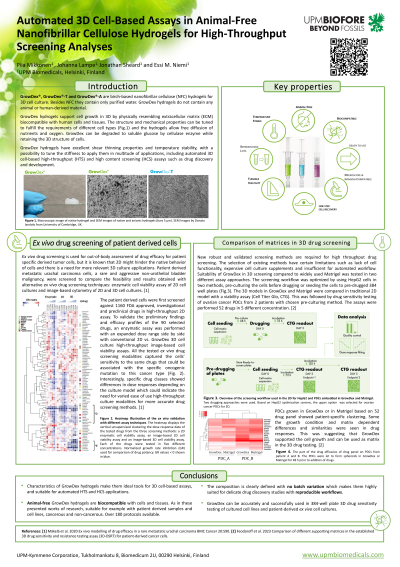
Abstract: Research in precision medicine requires predictive, biologically relevant, and cost-effective tissue mimicking cell models. 3D cell culture with hydrogels has become a powerful tool for examination of better in vivo relevancy for more relevant clinical drug responses and are being compared to more traditional well-established 2D monolayer models. GrowDex® hydrogels are plant-derived nanofibrillar cellulose hydrogels and have shown to provide an effective and experiment-reproducible 3D matrix for various healthy and cancerous cell types. The hydrogels resemble physically the extracellular matrix, support cell growth, spheroid, and organoid formation, and allow free diffusion of small molecules such as nutrients, drugs and oxygen. The hydrogels are shear thinning, temperature stable and have extremely low lot-to-lot variability, ideal to scale up automated 3D cell-based assays for drug discovery and development.
GrowDex was utilized for ex vivo drug screening of vital tumor patient derived cells (PDCs) to assess drug efficacy. After a preliminary 2D screening of 1160 FDA approved/investigational/preclinical drugs for metastatic urachal carcinoma cells, selected 90 drugs were screened more closely to compare 2D enzymatic assay vs. GrowDex 3D model for drug screening in high-throughput image-based viability and enzymatic assays. All the tested models captured the cells’ sensitivity to the same drugs that could be associated with the investigated oncogenic mutation specific to this cancer. However, specific drug classes showed differences in dose responses 2D vs. 3D which could indicate method and choice of assay-based bias in the results for the ex vivo screening assays.1
In another study, suitability of GrowDex and widely used Matrigel was tested side-by-side as 3D growth supporting matrices for high throughput drug sensitivity and resistance testing (3D-DSRT) in 384 well plate format. First optimizations were performed with hepatocyte cell line (HepG2) with two methods: pre-culturing or pre-drugging and compared to traditional 2D model with a viability assay. This was followed by drug sensitivity testing of ovarian cancer PDCs from two patients. The PDCs were tested with 52 drugs in 5 different concentrations using 3D-DSRT. This proof-of-concept study showed the growth condition and matrix dependent differences in drug sensitivities of ovarian cancer PDCs.2
These studies indicate the need for varied HTS modalities for more in vivo relevant and accurate drug screening methods to find the most effective treatment for the patient. Biologically relevant GrowDex hydrogels are a great option as the properties are suited for automated platforms for high-throughput screening.



.jpg "Piia Mikkonen photo")