(1062-A) Characterization of human iPSC-derived induced excitatory neurons for disease modelling and drug discovery
Wednesday, May 24, 2023
13:30 - 14:30 CET
Location: Hall 3
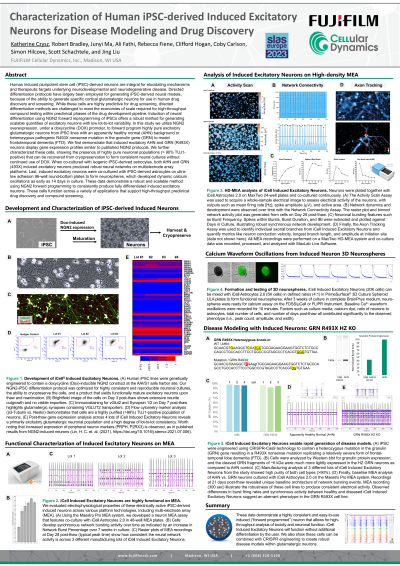
Abstract: Human induced pluripotent stem cell (iPSC)-derived neurons are integral for elucidating mechanisms and therapeutic targets underlying neurodevelopmental and neurodegenerative disease. Directed differentiation protocols have largely been employed for generating iPSC-derived neural models, because of the ability to generate specific cortical glutamatergic neurons for use in human drug discovery and screening. While these cells are highly predictive for drug screening, directed differentiation methods are challenged to meet the economies of scale required for high-throughput compound testing within preclinical phases of the drug development pipeline. Induction of neural differentiation using NGN2 forward reprogramming of iPSCs offers a robust method for generating scalable quantities of excitatory neurons with low lot-to-lot variability. In this study we utilize NGN2 overexpression, under a doxycycline (DOX) promoter, to forward program highly pure excitatory glutamatergic neurons from iPSC lines with an apparently healthy normal (AHN) or heterozygous pathogenic R493X nonsense mutation in the progranulin gene (GRN) to model frontotemporal dementia (FTD). We first demonstrate that induced excitatory AHN and GRN (R493X) neurons display gene expression profiles similar to published NGN2 protocols. We further characterized these cells, showing the presence of highly pure neuronal populations (> 90% Tuj-1+) that can be recovered from cryopreserved to form consistent neural cultures without continued use of DOX. When co-cultured with isogenic iPSC-derived astrocytes, both AHN and GRN (493X) induced excitatory neurons produced robust neural networks on multielectrode array platforms (Axion and Maxwell). Last, induced excitatory neurons were co-cultured with iPSC-derived astrocytes on ultra-low adhesion 96-well round-bottom plates to form neurospheres. After 14 days, AHN and GRN (493X)-containing neurospheres developed dynamic calcium oscillations, whose patterns were altered by addition of known neuromodulatory compounds (DNQX, AP5). These data show a robust and scalable method using NGN2 forward reprogramming to consistently produce fully differentiated induced excitatory neurons. These cells function across a variety of applications that support high-throughput preclinical drug discovery and compound screening