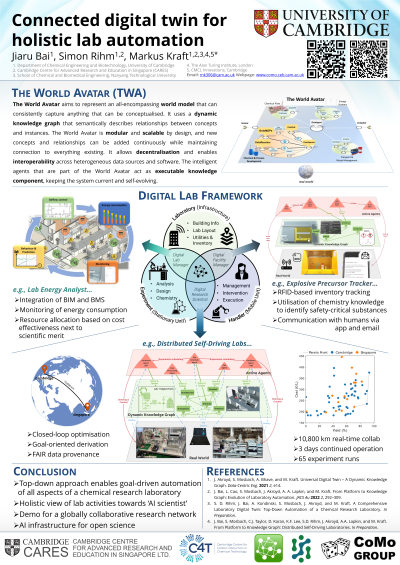
(1066-A) Developing comprehensive digital twins of research laboratories: Introducing a systems engineering approach
Wednesday, May 24, 2023
13:30 - 14:30 CET
Location: Hall 3
Abstract: In order to tackle many of humanity’s most pressing challenges, scientific discovery needs to be substantially accelerated. The automation of research activities plays a big role in this, from ubiquitous software tools to “self-driving laboratories” [1]. Recently, the idea of an “AI scientist” that can make Nobel-worthy discoveries has been introduced in this context [2]. We argue, that current platform-based “bottom-up” approaches are not sufficient and might even limit further development [3]. Therefore, we introduce a holistic lab automation framework as part of The World Avatar project, an all-encompassing digital twin based on dynamic knowledge graph. Its hierarchical semantic and semantic structure allow for deep representation of knowledge across different domains and scales. We argue it necessary to further interoperability by widening the search and optimisation space to include managerial tasks in research labs as well as information on infrastructure and buildings. This way we can ensure cost effectiveness, improve reproducibility, and free up human resources for creative tasks [1]. To achieve this, an unconventional “top-down” approach is applied to lab automation in the style of systems engineering. This approach aims to integrate all aspects of lab work and its automation, contrasting the many isolated solutions available that – amongst others – increase the risk of manufacturer lock-in. It also enables top-down goal derivation, subsequent design of experiment, and optimal resource distribution according to freely definable objective functions. In one instance, we were able to set up and run a distributed network of self-driving laboratories for flow chemistry. Our approach utilises ontologies to capture the data and material flows involved in a design-make-test-analyse cycle and employs autonomous agents as executable knowledge components to carry out the experimentation workflow. All data provenance is recorded following FAIR principles, ensuring its accessibility and interoperability. We demonstrate the practical application of our framework by linking two robotic setups in Cambridge and Singapore to achieve a collaborative closed-loop optimisation for an aldol condensation reaction in real time. The knowledge graph evolves on its own while progressing towards the research goals set by the scientist. The framework successfully generates the Pareto front for the yield-cost optimisation problem.
Key
References:
[1] Seifrid, M. et al. Autonomous Chemical Experiments: Challenges and Perspectives on Establishing a Self-Driving Lab. Acc. Chem. Res. 55, 2454–2466 (2022).
[2] Kitano, H. Nobel Turing Challenge: creating the engine for scientific discovery. npj Syst. Biol. Appl. 7, 1–12 (2021).
[3] Bai, J. et al. From Platform to Knowledge Graph: Evolution of Laboratory Automation. J. Am. Chem. Soc. Au 2, 292–309 (2022).