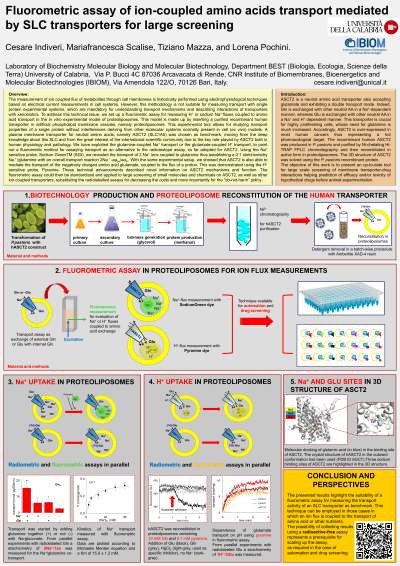
(1072-A) Flurorometric assay of ion coupled amino acids transport mediated by SLC transporters for large screening
Wednesday, May 24, 2023
13:30 - 14:30 CET
Location: Hall 3
Has Audio
Abstract: The measurement of ion coupled flux of metabolites through cell membranes is historically performed using electrophysiological techniques based on electrical current measurements in cell systems. However, this methodology is not suitable for measuring transport with single protein experimental systems, which are mandatory for understanding transport mechanisms and describing interactions of transporters with xenobiotics. To address this technical issue, we set up a fluorometric assay for measuring H+ or sodium Na+ fluxes coupled to amino acid transport in the in vitro experimental model of proteoliposomes. This model is made up by inserting a purified recombinant human transporter in artificial phospholipid membrane vesicles, namely proteoliposomes. This experimental tool allows for studying transport properties of a single protein without interferences deriving from other molecular systems normally present in cell (ex vivo) models. A plasma membrane transporter for neutral amino acids, namely ASCT2 (SLC1A5) was chosen as benchmark, moving from the deep knowledge about this SLC and from the great interest of the international scientific community due to the key role played by ASCT2 both in human physiology and pathology. ASCT2 is a neutral amino acid transporter also accepting glutamate and exhibiting a double transport mode, i.e., antiport of neutral amino acids or glutamate that is dependent on extracellular sodium or proton, respectively. This transporter is crucial for highly proliferating cells, whose need for glutamine is much increased. Accordingly, ASCT2 is over-expressed in most human cancers thus representing a hot pharmacological target. The recombinant human ASCT2 was produced in P. pastoris and purified by Ni-chelating Hi-TRAP FPLC chromatography and then reconstituted in active form in proteoliposomes. The 3D structure of ASCT2 was solved using the P. pastoris recombinant protein. We have exploited the glutamine coupled Na+ transport or the glutamate coupled H+ transport, mediated by ASCT2, for pointing out a fluorometric method for assaying transport as an alternative to the radioisotope assay, so far adopted. Using the Na+ sensitive probe, Sodium GreenTM (SGI), we revealed the transport of 2 Na+ ions coupled to glutamine thus establishing a 2:1 stoichiometry Na+/glutamine with an overall transport reaction 2Na+-aaex/aain. With the same experimental setup, we showed that ASCT2 is also able to mediate the transport of the negatively charged amino acid glutamate, coupled to the flux of a proton. This was demonstrated using the H+ sensitive probe, Pyranine. These technical advancements described novel information on ASCT2 mechanisms and function. The fluorometric assay could then be standardized and applied to large screening of small molecules and chemicals on ASCT2, as well as other ion coupled transporters, substituting the radiolabelled assays for decreasing the costs and more importantly for the “do-not-harm” policy.