(1078-A) High throughput characterization of advanced 3D liver models for in vitro hepatotoxicity studies
Wednesday, May 24, 2023
13:30 - 14:30 CET
Location: Hall 3
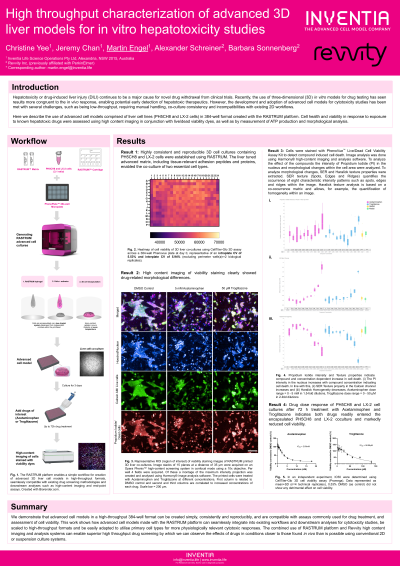
Abstract: Hepatotoxicity or drug-induced liver injury (DILI) continues to be a major cause for novel drug withdrawal from clinical trials. In more recent times, the use of three-dimensional (3D) in vitro models for drug testing has seen results more congruent to the in vivo response, enabling potential early detection of hepatotoxic therapeutics. However, the development and adoption of advanced 3D cell models for cytotoxicity studies has been met with several challenges, such as being low-throughput, requiring manual handling, temperature control and incompatibilities with existing 2D workflows.
Here we describe 3D hydrogel co-culture models using liver cell lines in 384-well format created with the RASTRUM platform. Cell health and viability in response to exposure to known hepatotoxic drugs were assessed using high content imaging in conjunction with live/dead viability dyes, as well as by measurement of ATP production. Cellular injury were assessed by immunoassays.
We demonstrate that advanced cell models in a high-throughput 384-well format can be created simply, consistently and reproducibly, and are compatible with assays commonly used for drug treatment, and assessment of cell viability in 2D culture models. This work shows how advanced cell models made with the RASTRUM platform can seamlessly integrate into existing workflows and downstream analyses for cytotoxicity studies, be scaled to high-throughput formats and be easily adapted to utilise primary cell types for more physiologically relevant cytotoxic responses.