(1063-B) Citron kinase: the tasty juice of the early drug discovery
Thursday, May 25, 2023
13:30 - 14:30 CET
Location: Hall 3
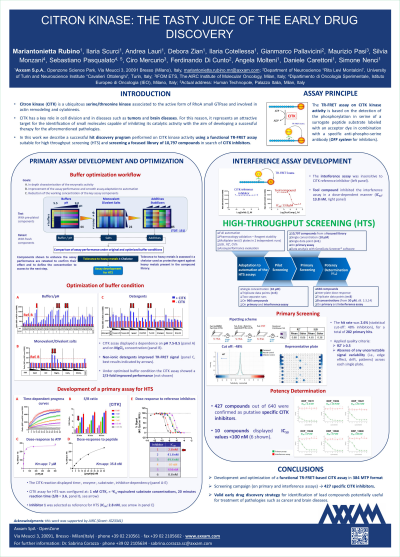
Abstract: Citron kinase (CITK) is a ubiquitous serine/threonine kinase that was originally identified for its capability to specifically bind the active form of RhoA small GTPase, leading to the hypothesis of its involvement in actin remodeling and cytokinesis1. More than two decades later, several studies clearly indicate the important role of CITK in cell division and human diseases. CITK is a multifunctional kinase that has been proposed as an attractive target for CNS diseases and cancers[1,2,3,4]. A recombinant version of CITK has been used to develop a TR-FRET assay in 384 MTP format on its catalytic activity. The in vitro kinase activity was measured by detecting the phosphorylation in serine of a surrogate peptide substrate labeled with an acceptor dye in combination with a specific anti-phospho-serine antibody. The CITK assay has been optimized by screening a matrix of 150 alternative components of the reaction buffer, yielding a deep biochemical characterization of its catalytic activity. The optimized CITK assay has been configured as primary assay for high-throughput screening (HTS) and validated using a panel of reference inhibitors, displaying IC50 values in the pM-nM range. Moreover, a secondary assay has been developed for the identification of hit compounds interfering with the readout system. The primary assay has been used to screen a focused collection of 10,797 compounds in search of CITK inhibitors. The hit rate in primary screening was 2.6% (statistical cut-off: 48% inhibition). Among the 640 compounds promoted to potency determination, 427 have been confirmed as putative CITK inhibitors, with IC50 values in the high nM-low µM range and no activity on the secondary assay. In conclusion, we provide evidence of a successful hit discovery program that has led to the identification of innovative lead candidates for the treatment of pathologies such as cancers and brain diseases. Acknowledgments: this work has been supported by Associazione Italiana per la Ricerca sul Cancro (AIRC --Grant IG23341).
[1] Di Cunto F. et al., "Citron rho-interacting kinase, a novel tissue-specific ser/thr kinase encompassing the Rho-Rac-binding protein Citron" J Biol Chem. (1998) [2] D’Avino PP, “Citron kinase – renaissance of a neglected mitotic kinase”, Journal of Cell Science (2017) [3] Liu Z et al., “Down-regulation of CIT can inhibit the growth of human bladder cancer cells”, Biomedicine & Pharmacotherapy (2020) [4] Pallavicini G et al., “Inactivation of Citron Kinase Inhibits Medulloblastoma Progression by Inducing Apoptosis and Cell Senescence”, Cancer Research (2018)