(1071-B) Exploring the Landscape of PARP Inhibitor Selectivity in Live Cells Using NanoBRET™ Target Engagement Assays
Thursday, May 25, 2023
13:30 - 14:30 CET
Location: Hall 3
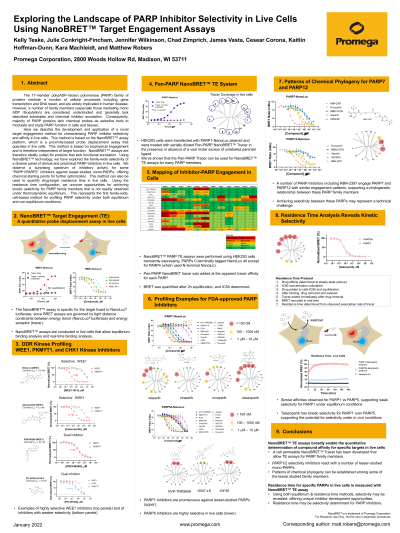
Abstract: The 17-member poly(ADP-ribose) polymerase (PARP) family of proteins mediate a number of cellular processes including gene transcription and DNA repair, and are widely implicated in human disease. However, a number of family members (especially those mediating mono ADP ribosylation) are considered understudied and generally lack described substrates and chemical inhibitor annotation. Consequently, majority of PARP proteins lack chemical probes as selective tools to modulate and study PARP function in cells and tissues. Here we describe the development and application of a novel target engagement method for characterizing PARP inhibitor selectivity and affinity in live cells. This method is based on the NanoBRET™ assay platform, which is a proximity-based probe displacement assay that operates in live cells. This method is based on biophysical engagement and is therefore independent of target function. NanoBRET™ assays are therefore ideally suited for proteins that lack functional annotation. Using NanoBRET™ technology, we have explored the family-wide selectivity of a diverse panel of clinical and preclinical PARP inhibitors in live cells. We observe a surprising spectrum of inhibitory activity for some “PARP1/PARP2” inhibitors against lesser-studied mono-PARPs, offering chemical starting points for further optimization. This method can also be used to quantify drug-target residence time in live cells. Using the residence time configuration, we uncover opportunities for achieving kinetic selectivity for PARP family members that is not readily observed under thermodynamic equilibrium. This represents the first family-wide, cell-based method for profiling PARP selectivity under both equilibrium and non-equilibrium conditions.