(1085-B) Multiplexing Enzyme Reactions Using RapidFire Mass Spectrometry
Thursday, May 25, 2023
13:30 - 14:30 CET
Location: Hall 3
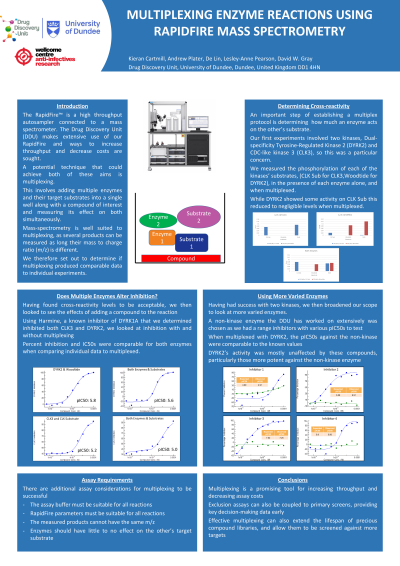
Abstract: The Agilent RapidFire™ is a high throughput autosampler. It contains a robot arm and solid phase extractor that injects samples into the connected triple quadrupole mass spectrometer. A standard RapidFire screen within The University of Dundee’s Drug Discovery Unit (DDU) usually involves around 50,000 compounds in 384-well plate format. This equates to roughly 140 hours of machine time. The DDU makes great use of the RapidFire system across various target-based discovery programs. Identifying ways to maximise its throughput while maintaining a high standard of data quality is of great interest.
During a biochemical screen, each well contains a test compound along with an enzyme and its target substrate(s). However, throughput could be increased through multiplexing; including two (or more) enzyme targets when carrying out a screen. Each well would still include a single compound, but additional enzymes, along with their target substrates would be added. As well as improving throughput, multiplexing could potentially preserve compound stocks, reduce wet work time, and allow selectivity screens to be carried out simultaneously.
To determine if this was a viable strategy for screening, we tested multiple enzymes with known inhibitors in both single and multiplexed assays and determined their IC50s. The results were positive, and even enzymes that shared common inhibitors reflected their non-multiplexed counterparts. While effective, multiplexing enzyme reactions has additional assay development considerations, and these are also presented.