(1024-A) NanoBRET Approach for Characterizing the Impact of RAS Pathway Inhibitors on Protein Interactions in Live Cells
Wednesday, May 24, 2023
13:30 - 14:30 CET
Location: Hall 3
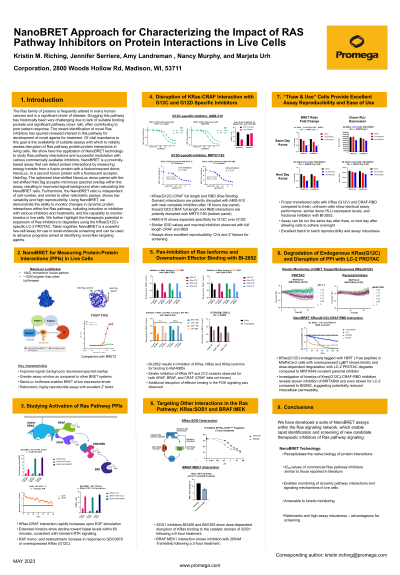
Abstract: The Ras family of proteins is frequently altered in many human cancers and is a significant driver of disease. Drugging this pathway has historically been very challenging due to lack of suitable binding pockets and significant pathway cross- talk, often contributing to poor patient response. The recent identification of novel Ras inhibitors has spurred renewed interest in this pathway for development of novel agents for treatment. Of vital importance to this goal is the availability of suitable assays with which to reliably assess disruption of Ras pathway protein:protein interactions in living cells. We show here the application of NanoBRET technology to study Ras pathway interactions and successful modulation with various commercially available inhibitors. NanoBRET is a proximity-based assay that can detect protein interactions by measuring energy transfer from a fusion protein with a bioluminescent donor, NanoLuc, to a second fusion protein with a fluorescent acceptor, HaloTag. The optimized blue-shifted NanoLuc donor paired with the red-shifted HaloTag acceptor minimizes spectral overlap within the assay, resulting in improved signal:background when calculating the NanoBRET ratio. Furthermore, the NanoBRET ratio is independent of cell number, and similar to other ratiometric assays, shows low variability and high reproducibility. Using NanoBRET, we demonstrate the ability to monitor changes in dynamic protein interactions within the Ras pathway, including induction or inhibition with various inhibitors and treatments, and the capability to monitor kinetics in live cells. We further highlight the therapeutic potential in expansion of Ras inhibitors to degraders using the KRas(G12C)-specific LC-2 PROTAC. Taken together, NanoBRET is a powerful live-cell assay for use in small-molecule screening and can be used to advance programs aimed at identifying novel Ras targeting agents.