(1097-B) SYNTAX system enables rapid probe synthesis and testing to accelerate custom qPCR assay development
Thursday, May 25, 2023
13:30 - 14:30 CET
Location: Hall 3
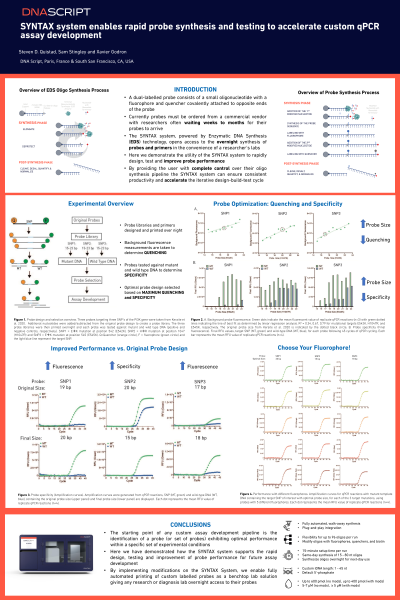
Abstract: Quantitative PCR (qPCR) is a molecular biology technique utilized across a range of applications from gene expression analysis to pathogen detection. One of the most common approaches in qPCR utilizes dual-labelled probes. The SYNTAX system, powered by Enzymatic DNA Synthesis (EDS) technology, is capable of printing 96 probes with up to three different fluorophores in less than 8 hours. Normalized probes can then be directly tested, redesigned and retested drastically reducing assay development timelines. EDS offers several advantages compared to traditional chemical methods including printing DNA in the direction of biology (5’ to 3’), using non-flammable solvents during manufacturing and requiring only 2-steps versus 5 resulting in an overall better cycle efficiency. Here we demonstrated the utility of SYNTAX in assay development within the context of the Phosphoinositide 3-Kinase (PI3K) pathway. PI3K’s are a family of enzymes that play a central role in cellular proliferation and misregulation of the PI3K system has been implicated in a variety of cancers. Three previously published probes targeting three of the most common hotspot mutations in the PIK3CA gene were selected as a starting scaffold for probe design iteration. A probe library containing different sized probes with a variety of fluorophores was then printed overnight on SYNTAX. Each probe was then tested for specificity against wild type and mutant DNA. The highest performing probe for each target was then selected for assay development based on maximum fluorescent signal and target specificity. These data demonstrate the potential for SYNTAX to enable rapid design and testing of custom labelled probes to accelerate qPCR assay development.