(1082-A) Kinome Profiling with Continuous Assays and Integration of Automated Linear Range Determination to Accelerate Generation of Improved Drug Treatments
Wednesday, May 24, 2023
13:30 - 14:30 CET
Location: Hall 3
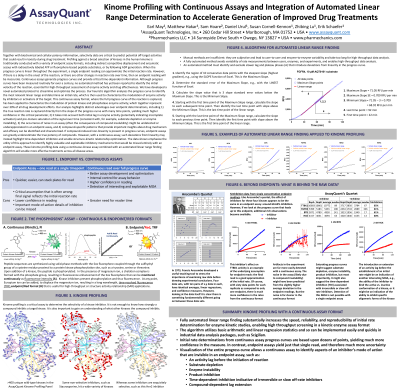
Abstract: Together with biochemical and cellular potency information, selectivity data are critical to predict potential off-target activities that could result in toxicity during drug treatment. Profiling against a broad selection of kinases in the human kinome is traditionally conducted with a variety of endpoint assay formats, including indirect competitive displacement and enzymatic assays with radioactively labeled ATP or fluorophore-based peptide substrates, or by following ADP generation. When the progress curve is linear throughout the experiment, a single endpoint reading can approximate the initial reaction rate. However, if there is a delay in the onset of the reaction, or there are other changes in reaction rate over time, then an endpoint reading will be inaccurate. Continuous assays generate progress curves and provide critical time-dependent information. Although progress curves have been measured routinely for over a century, no automated method has yet been reported to identify the initial velocity of the reaction, essential for high-throughput assessment of enzyme activity and drug effectiveness. We have developed a novel automated protocol to streamline and optimize the process. Our heuristic algorithm analyzes the progress curve to identify the most relevant linear range and determine an initial rate, which is then used to characterize the modulation of enzyme activity by inhibitors or activators of the target. This continuous assay format, where the full progress curve of the reaction is captured, has been applied to characterize the modulation of protein kinase and phosphatase enzyme activity, which together represent over 30% of all drug development efforts. Our analysis highlights distinct advantages over endpoint determinations, including 1) the true reaction rate is captured directly from the slope of the progress curve with many time points, yielding much higher confidence in this critical parameter, 2) it takes into account both initial lag in enzyme activity (potentially indicating incomplete activation) and pre-mature saturation of the signal over time (consistent with, for example, substrate depletion or enzyme instability), 3) the occurrence of noise in an assay (often the consequence of compound insolubility) might be undetected or underappreciated in an endpoint assay, and 4) compound-specific patterns that provide important insights about drug mechanism and efficacy can be identified and characterized. If compound-induced non-linearity is present in progress curves, endpoint assays can greatly underestimate the true potency of compounds. However, with a continuous assay, such deviations from linearity may instead highlight time-dependent inhibition and enable structure-kinetic relationship optimization. The data shown emphasize the utility of this approach to identify highly valuable and exploitable inhibitory mechanisms that would be missed entirely with an endpoint assay. These kinome profiling data using a continuous kinase assay combined with an automated linear range finding algorithm will enable more effective treatments across all disease areas.