(1053-B) Application of an isogenic human iPSC-derived blood brain barrier (BBB) model
Thursday, May 25, 2023
13:30 - 14:30 CET
Location: Hall 3
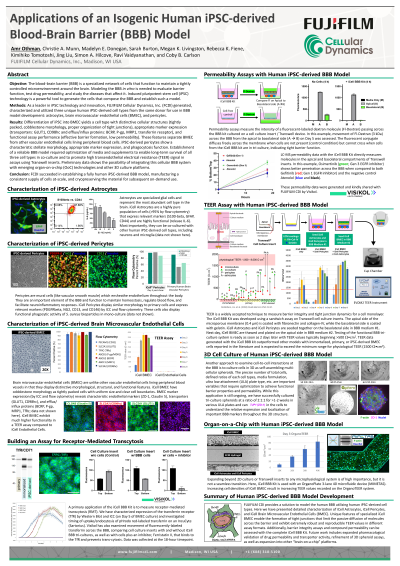
Abstract: The blood-brain barrier (BBB) is a specialized network of cells that function to maintain a tightly controlled microenvironment around the brain. A robust BBB model is needed to evaluate barrier function, test drug permeability, and study how different diseases can affect it. Harnessing the power of iPSC technology, we were able to generate specific cell types of the human brain required to assemble such a model, including astrocytes, pericytes, & brain microvascular endothelial cells (BMEC). Importantly, the same donor iPSC line (01279) was used to make each of these cell types, yielding a fully isogenic tri-culture system. Marker expression and other cellular characterization data has been presented previously; therefore, we focused on the functional performance of the BBB model in various assay platforms. The traditional trans-endothelial electrical resistance (TEER) assay using cell culture inserts resulted in robust & reproducible signal (>1500 ohms▪cm2) after 3 days. TEER measurements were further investigated using impedance-based instrumentation and barrier disruption with VEGF and mannitol was quantified. BBB permeability of fluorescent dextran molecules was assessed, and the apparent permeability of drug compounds (e.g., atenolol, caffeine, chlorpromazine, & propranolol) was quantified via LC-MS/MS. Generation of 3D spheres was accomplished using ULA plates and imaging revealed insightful structural features. Development of a receptor-mediated transcytosis assay was also initiated, beginning with characterization of transferrin receptor expression and evaluation of detection techniques. Finally, integration with emerging organ-on-a-chip technologies, such as MIMETAS OrganoPlate and Emulate Brain Chip, offers a unique way to further enhance biological complexity. Importantly, the keys to success here were consistency of supply made possible by differentiation at-scale resulting in large batches of cells, cryopreservation of all three cell types for subsequent on-demand use, and an optimized formulation of media/supplements to enable long-term survival. Taken together, this study highlights the modular and flexible nature of an isogenic human iPSC-derived BBB model as a new capability to advance the understanding of BBB function with respect to human health and disease.