(1055-B) Automated In Vitro MDCKII-BCRP Monolayer Assay with Ultra-Fast LC-MS/MS
Thursday, May 25, 2023
13:30 - 14:30 CET
Location: Hall 3
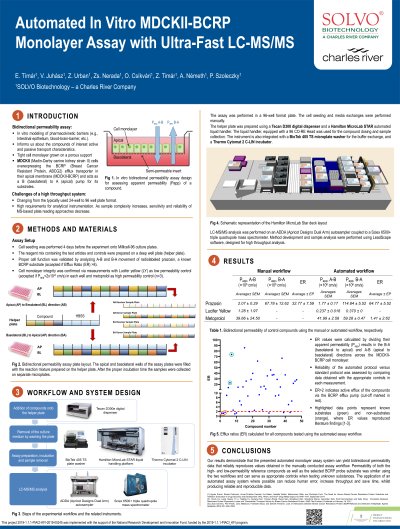
Abstract: Automated In Vitro MDCKII-BCRP Monolayer Assay with Ultra-Fast LC-MS/MS E. Tímár, V. Juhász, Z. Urban, Zs. Nerada, O. Csíkvári, Z. Tímár, A. Németh, P. Szoleczky Charles River Laboratories, Budapest, Hungary
The regulatory landscape for transporter-mediated drug-drug interactions has undergone a dramatic shift over recent years, with multiple revisions to relevant guidance documents released by multiple regulatory agencies and most recently the M12 draft guidelines by the ICH. The appropriate in vitro investigation of the interactions of a drug with transporters can identify risks before first-in-human studies. For candidate selection, developers look to obtain in vitro data on a large number of compounds in early stages of development quickly and at a low cost. The aim of this study was to develop, test and evaluate a high-throughput system and workflow for generating in vitro data from a large number of samples in a fast, accurate and cost-efficient manner. The purpose of the experiments was to evaluate transporter interactions of 50 compounds in vitro in a bidirectional permeability assay using BCRP overexpressing MDCKII cells. MDCKII (Madin-Darby canine kidney strain II) cells form a tight monolayer on suitable transwell membrane that separates two fluid compartments. Transporter proteins, present in the cell membrane, can have crucial influence on material traffic between the two separated compartments. One important of such transporters is the BCRP (Breast Cancer Resistant Protein, ABCG2), which is an efflux transporter. Efflux transporters prevent tissues such as the brain, gut or tumors from potentially toxic exogenous drugs and are also involved in biliary and renal excretion. BCRP is highly expressed in the colon, small intestine, blood-brain barrier (BBB), placenta and liver canalicular membrane. Preliminary assay steps were performed using a Tecan D300 dispenser and the assay itself was automated on a Hamilton Star liquid handling platform. The Hamilton Star is equipped with a 96 channel pipetting head and is integrated with a Thermo Cytomat 2 C-LIN incubator and a BioTek 405 TS microplate washer. After the assay was performed, samples were diluted with cold acetonitrile containing a generic internal standard for mass spectrometry. Following the protein precipitation, a centrifugation was applied and the supernatant was injected with a dual arm autosampler (ADDA) directly from the 96-well plates onto the dual stream LC-MS/MS system. Using this system, we achieved a throughput of 15 seconds/sample with superb separation power and peak capacity (compared to a different vendor HT-LC-MS/MS). Accuracy of the automated protocol versus manual protocol was assessed by comparing efflux ratios (ER). The measured ERs were equivalent between protocols for all investigated compounds. The automated assay system presented here therefore provides a tool for generating reliable in vitro transporter interaction data with short turnaround times, while also reducing the chance for human error.