


Shaping the Future of Therapeutics
Poster Session A
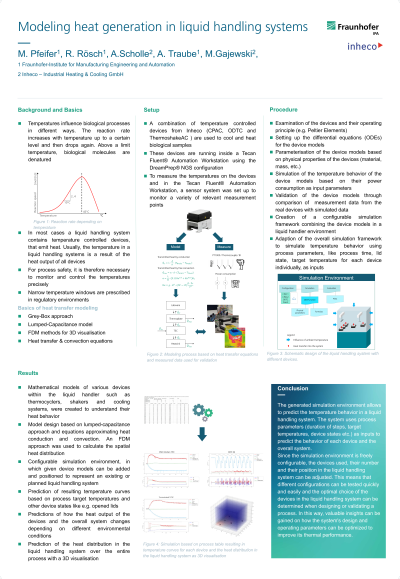
Automated liquid handling for next-generation sequencing library preparation requires well defined and constant ambient parameters. Liquid handling platforms can help to increase reproducibility and throughput, however, varying assay conditions due to heat emission by integrated third party devices and changes in humidity pose serious challenges to the accuracy of the assay. Unknown temperature deviations can have significant influences on both the assay, the functions of technical components but also of input materials. For example, elevated temperatures can favor evaporation processes or inhibit or favor biochemical reactions. For this reason, a narrow temperature window is prescribed in regulatory environments, e.g. in diagnostics, which must be tested and validated. In the light of the fact that next generation liquid handling systems are fully enclosed due to user safety regulations and to protect sample and Kit chemistry from environmental influence the heat management is even more important.
In order to predict and monitor ambient parameters on closed liquid handling platforms and thus analyse their impact on the assay outcome, we have developed a model algorithm for the prediction of the temperature development. The final aim of the project was to develop a heat management system that can be used to make predictions and process simulations of heat effects and that applies a parameterization so flexible that the heat management system can be transferred to liquid handling systems from any manufacturer and any assay. We used a Tecan Fluent® platform available at Fraunhofer IPA as a model system, which had integrated thermal and shaking devices from Inheco, and we performed NGS steps. Heat input from the individual devices was acquired using thermal imaging camera, measuring power consumption and by direct temperature measurements in an artificial test chamber. Furthermore, heat exchange by convection/heat conduction was analysed. Summative heat maps were finally generated on the liquid handling platform on the course of a predefined workflow.
Feeding all data into differential equations, enabled us to develop a configurable algorithm, which was capable to integrate device classes in a parametrized fashion. Doing so we were able to predict heat development on the liquid handling platform. We also compared integration of different devices and methods for heat removal within the system. Our algorithm thereby helped to select an optimal platform configuration in terms of heat management prior to platform assembly and also allows better process predictivity and more accurate assay results.

Michael Pfeifer, Dipl.-Ing.
Project Manager
Fraunhofer IPA
Stuttgart, Baden-Wurttemberg, Germany