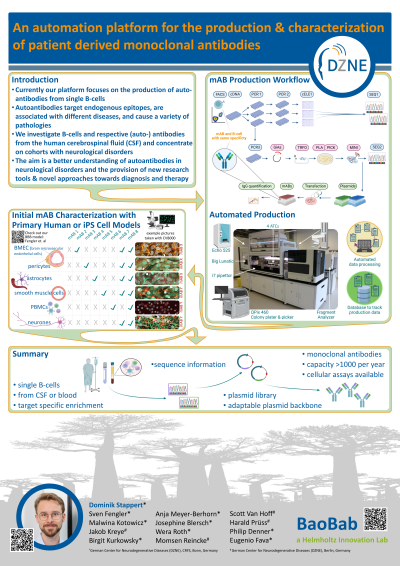
(1022-A) An automation platform for the production and characterization of patient derived monoclonal antibodies
Wednesday, May 24, 2023
13:30 - 14:30 CET
Location: Hall 3
While engineered antibodies are reshaping the drug landscape, naturally occurring human antibodies receive growing attention as disease-specific entities. Autoantibodies target endogenous epitopes and cause a variety of pathologies including autoimmune neurological disorders (Prüss 2021). From a different perspective, individual natural antibodies are a potential source for new drug candidates. A major bottleneck towards a better, more systematic understanding of (auto)antibody repertoires in disease backgrounds and their effects is the large-scale production of monoclonal antibodies from individual B-cells. We have recently established a platform for highly automated antibody production covering molecular biology, microbiology, and cell biology. Antibody coding cDNA from individual B-cells is amplified and cloned into expression vectors. HEK cells are then transiently transfected to produce recombinant human monoclonal antibodies recapitulating the specificity of the originating B-cell (Kreye et al. 2020). The production pipeline is flanked with a dedicated database, containing antibody and donor metadata, enabling efficient hypothesis building. As we currently focus on neurological disorders and cerebrospinal fluid derived human antibodies, we have established a set of human cell models, based on either primary cells or iPS-derived neuronal cells (Fengler et al. 2022). Together these models partly recapitulate brain architecture and allow functional insights. Collectively, our Brain antibody-omics and B-cell Lab (BaoBab) platform provides function insights into the human brain antibody repertoires in health and disease. Here, we present our platform with the focus on the utilized automation equipment and present the preliminary results of the first 1000 antibodies produced.