


Frontiers in Technology
Poster Session A
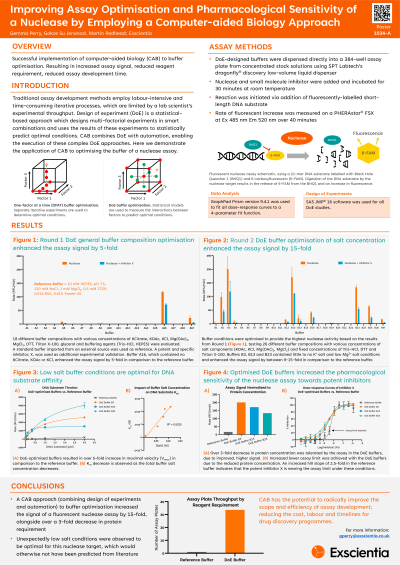
Traditional assay development methods are often labour-intensive, time-consuming and limited by the experimental throughput of a lab scientist. Design of Experiments (DoE) is a statistical-based approach which designs multi-factorial experiments in smart combinations, and uses the results of these experiments to statistically predict optimal conditions. Computer-aided biology (CAB) combines DoE with automation, enabling the execution of these complex DoE experiments. The CAB approach to assay development enables the rapid determination of optimal conditions by allowing a scientist to test tens of thousands of factors in just one or two experiments. Here, we demonstrate the application of an Exscientia-developed CAB method to the buffer optimisation of a nuclease assay, where we saw an increase in signal-background of 15-fold and a decrease in protein requirement by over 3-fold, in conditions which were not readily obvious from literature. This assay, which was previously unstable and with low signal using standard conditions, is now robust and highly sensitive. Thus, demonstrating the power of CAB to simultaneously improve an assay’s performance and reduce the cost, labour and timelines for drug discovery programmes.

Gemma Skye Perry, MSc (she/her/hers)
Research Drug Discovery Biochemist
Exscientia
Oxford, England, United Kingdom