(1005-B) Automation of host cell protein analysis by mass spectrometry: Increased speed and reproducibility, from sample preparation to report
Thursday, May 25, 2023
13:30 - 14:30 CET
Location: Hall 3
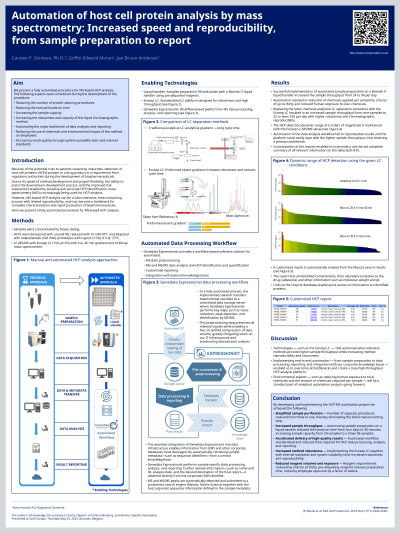
Abstract: Detection of host cell proteins (HCPs) present in a drug product is a requirement from regulatory authorities during the development of biopharmaceuticals. Traditionally, HCP detection is performed using Enzyme-Linked Immunosorbent Assay (ELISA). However, ELISA has a long development time, does not provide protein identity, and is cell-line specific. HCP analysis by mass spectrometry (HCP-MS) is a trending technique due to its speed of method development and project flexibility, the ability to assist the downstream development process, and the improved risk assessment enabled by sensitive and accurate HCP identification. HCP-MS can however be a labour-intensive, time-consuming process with limited reproducibility, and may become a bottleneck for complete characterisation and rapid production of biopharmaceuticals. Starting from a complex proteomics workflow, we have developed an analytical setup in which each step was optimized and automated to improve robustness and save time. Initial changes involved improvements to the chromatographic stages; namely, replacing custom-made nano-HPLC columns with an off-the-shelf solution (Evosep®). This not only increased the throughput from approximately eight samples per day to a minimum of 30 — thereby meeting the requirements of higher analytical speed — but also delivered the improved reproducibility associated with advanced and standardised chromatographic solutions. To match the increased LC capacity of our HCP assay, sample content normalisation and sample preparation were transferred to a liquid handler to further increase the speed and reproducibility. The data analysis of the mass spectrometry raw files was automatised with a vendor-neutral client-server solution to increase processing speed, standardise processing, and improve reproducibility. A subsequent automated reporting step compiles the data from various sources and generates the final report. As a proof-of-concept, we investigated technical replicates to evaluate the overall reproducibility while defining the gains in efficiency. The reproducibility of the liquid handler for sample preparation was tested across a range of Evosep LC gradients (30, 60, 100, 200, 300 samples per day) in at least five replicates. A combination of simple and complex protein samples was analysed, including samples extracted during process development that contained different levels of HCPs. Customised data analysis visualisations facilitated evaluation of results and enabled conclusions to be drawn with confidence. This optimized setup and workflow have significantly increased the capacity and reproducibility of the MS-based HCP assay through automation of the analytical procedure, replacing custom-made products with off-the-shelf solutions, and automating data analysis and subsequent reporting. Here we present the gains in efficiency that these improvements brought to the process.