(1011-B) High throughput contactless volume verification for high density microtiter plates and microarrays
Thursday, May 25, 2023
13:30 - 14:30 CET
Location: Hall 3
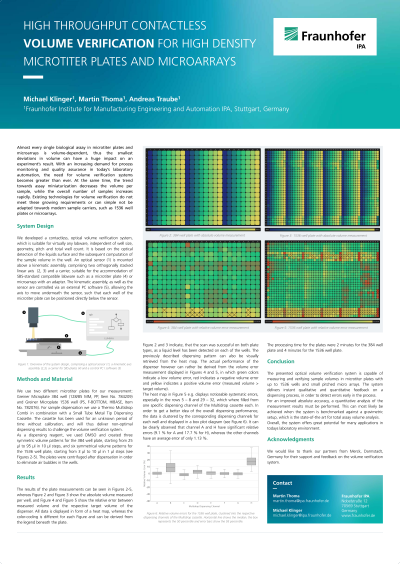
Abstract: Almost every single biological assay in microtiter plates and microarrays is volume-dependent, thus the smallest deviations in volume can have a huge impact on an experiment’s result. With an increasing demand for process monitoring and quality assurance in today’s laboratory automation, the need for volume verification systems becomes greater than ever. At the same time, the trend towards assay miniaturization decreases the volume per sample, while the overall number of samples increases rapidly. Existing technologies for volume verification do not meet these growing requirements or can simple not be adapted towards modern sample carriers, such as 1536 well plates or microarrays. We developed a contactless, optical volume verification system, which is suitable for virtually any labware, independent of well size, geometry, pitch and total count. It is based on the optical detection of the liquids surface and the subsequent computation of the sample volume. The benefits of the system are manifold: It is contactless, very fast and especially suitable for smaller sized wells like those of 1536 well plates, since it is possible to detect even low liquid levels in contrast to existing ultrasonic measurement systems. Additionally, the system can be used to measure even smallest volumes on other emerging labware, such as Droplet Microarrays (DMA) containing up to 6000 individual samples on the same area as a conventional microscopy glass slide. Furthermore, the system can be utilized to validate blank labware, before it is filled with costly samples, as deformation can be an issue on injection molded microtiter plates, possibly affecting analysis results in the downstream application. As the scan speed of the system is very fast, well volumes can also be measured repeatedly in order to analyze the kinetics of external factors such as evaporation. As a result, our sensor setup was able to measure the volumes of a 1536 well plate with an accuracy of 100nl and an overall process time of 200s. A droplet microarray (DMA) with 672 individual samples was processed in 25s and volumes were measured with an accuracy of 20nl.