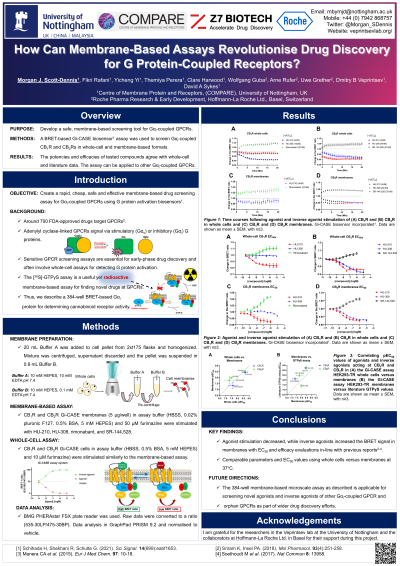
(1027-B) How can membrane-based assays revolutionise drug discovery for G protein-coupled receptors?
Thursday, May 25, 2023
13:30 - 14:30 CET
Location: Hall 3
Has Audio
The cannabinoid receptor (CBR) subtypes 1 (CB1R) and 2 (CB2R), are key components of the endocannabinoid system (ECS), playing a central role in the control of peripheral pain, inflammation, and the immune response, with further importance in the endocrine regulation of food intake and energy balance. So far, few medicines targeting these receptors have reached the clinic, suggesting that a better understanding of the receptor signalling properties of existing tool compounds and clinical candidates may open the door to the development of more effective and safer treatments.
Both CB1R and CB2R are G protein-coupled receptors (GPCRs) that signal via inhibitory G (Gi) proteins following receptor activation. However, studying signal transduction in GPCRs that couple through such G proteins, in a reliable and reproducible manner, is difficult. This is due to the inherent variability in live cell-based assays resulting from differences in receptor number and G protein expression. In addition, existing assays such as the [35S]-GTPgammaS assay come with various challenges resulting from the use of radioactive materials. Despite this, it remains a favoured technology as a high-throughput screening (HTS) method for screening novel drugs at Gi-coupled GPCRs such as the cannabinoid receptors.
Newer, more powerful tools have emerged to study GPCR signalling in whole, living cells. Such methods include the development of G protein tricistronic activity sensor (G-CASE) biosensors for Gi-coupled GPCRs (Gi-CASE biosensors), that enable the activity of functional G proteins to be studied following changes in the BRET signal. Essentially, these biosensors detect activation and dissociation of the heterotrimeric G protein upon ligand-receptor binding and G protein activation, by monitoring BRET between the alpha and beta-gamma subunits of the G protein.
Here, we incorporated these G protein biosensors into CB1R and CB2R membrane preparations derived from stable, living cells overexpressing CB1R or CB2R as well as the Gi-CASE biosensor. This was possible as the G protein is lipidated at the amino terminus of the alpha subunit of the G protein, and the carboxyl terminus of the beta-gamma subunit of the G protein.
Our membrane-based Gi-CASE nano-BRET system successfully characterised the potency (pEC50) and efficacy (Emax) of CBR- agonists and inverse agonists in a 384-well screening format, in-line with whole-cell Gi-CASE assays and consistent with literature values obtained in various screening formats. This novel, membrane-based assay may be applicable to other GPCRs that couple through Gi proteins, including orphan receptors, thus facilitating convenient real-time HTS measurements of receptor activation.