(1033-B) High throughput rapid sintering and dielectric characterization of ferroelectrics predicted by machine learning
Thursday, May 25, 2023
13:30 - 14:30 CET
Location: Hall 3
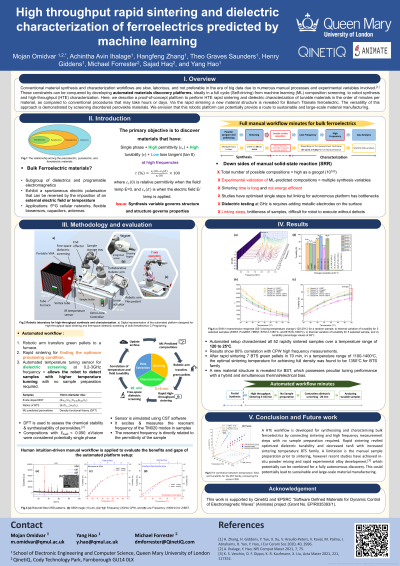
Abstract: Programmable electromagnetic materials have emerged as breakthrough research for dynamically manipulating waves and adding on-demand functionalities simply by installing software updates. It underpins next-generation technologies such as flexible biomaterials or 6G cellular networks that integrate sensing, navigation, communication, and computing. However, the availability of tunable materials, which translate programmable electromagnetics into practice, is limited across all frequency ranges due to the complexity of material design, long manufacturing process, and complex characterisation. These constraints can be conquered by developing accelerated material discovery platforms, ideally in a fully automated cycle from machine learning-driven screening to robotic synthesis and high throughput characterization which can lead to a Self-Driving Laboratory. However, most of the automation efforts in dielectric chemistry focus on synthesis and compound identification, with target property characterization receiving less attention. Here, an automated platform is introduced to perform high throughput rapid sintering and dielectric characterization of tunable materials in order of minutes per material, as compared to conventional procedures that may take hours or days. The advantages of this system are validated by synthesising and measuring BaxSr1-xTiO3 and BaTi1-zSnzO3 samples. The Automated High-Frequency Tunability Sensor (AHFTS) is developed for in-situ material characterization of thermal tunability, and the correlation between thermal and voltage tuning is also investigated. Especially, a new material structure is revealed through rapid sintering for BaxSr1-xTiO3, which possesses peculiar tuning performance with a hybrid and simultaneous thermal/electrical bias. The versatility of this approach is demonstrated by screening disordered perovskite materials and learning only from their chemical composition, manifested in the (A1xA′x)BO3 (A1xA′x)BO3 and (B1xB′x)O3 (B1xB′x)O3 formulae. Human intuition-driven manual workflow is applied to explore the benefits and gaps of robotic lab automation. We envision that this human-machine interactive learning approach to high-throughput material screening can be used across disciplines and potentially provides a route to sustainable and large-scale material manufacturing.