(1000-A) A dynamic scheduling method for autonomous maintenance of human iPS cells without human intervention.
Wednesday, May 24, 2023
13:30 - 14:30 CET
Location: Hall 3
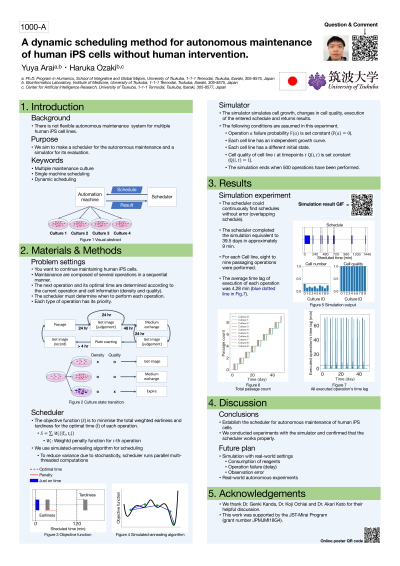
Abstract: In basic research and clinical applications, culturing multiple human iPS cell lines in parallel is crucial as it enables extensive studies with donor-derived, healthy and diseased cell lines. Moreover, it helps account for individual genetic differences, facilitates quality control and optimization of culture conditions. However, automating maintenance culture of multiple iPS cell lines in parallel is currently ill-matched with laboratory automation: different iPS cell lines have different growth curves, requiring modification of maintenance culture operations according to the cell conditions. To address this challenge, we designed a novel algorithm that dynamically adjusts the maintenance culture schedule for each iPS cell line based on their specific growth characteristics, thus ensuring optimal culture conditions and reducing manual intervention.
We first formulated the dynamic scheduling problem for the maintenance culture of human iPS cells by a single automation machine as follows: (1) the maintenance culture procedure consists of cell observation, medium change and passaging operations, (2) passaging operations are followed by several times medium change operations, (3) the subsequent passaging operations are performed based on cell observation results, (4) the scheduler needs to decide an operation performed next and its optimal time based on cell observation results, (5) the machine process all the operations, (6) the machine can process at most one operation at a time. (7) the objective function is the total weighted earliness and tardiness for the optimal time of each operation, (8) each cell line has a distinct growth curve.
Next, we developed a scheduler to determine which operation the machine should perform next. To efficiently evaluate the scheduler on the computer, we also developed a simulator for cell proliferation and experimental processing. The scheduler was implemented using a simulated-annealing method that minimises the objective function. We also developed a simulator for cell proliferation and experimental processing. The simulator receives a schedule and outputs the result. To evaluate the scheduler, we assessed the number of infeasible schedules (“overlapping schedules”) and the saved time.
We simulated the parallel maintenance culture of ten iPS cell lines to evaluate the scheduler's performance. We assume the iPS cell lines proliferate logistically, and any operation does not fail. As a result, our scheduler completed a simulation equivalent to 56,900 min (39.5 days) in approximately 9 min without an infeasible solution. This result suggests that an automation machine can conduct iPS cell-autonomous passaging continuously. Toward its application for real-world autonomous experiments, we are conducting simulations considering more complex situations such as resource consumption and operation failures.